
All images below are thumbnails only; Full versions may been seen in the SimHQ article.
Q&A
Patty Wagstaff
Aerobatic Flying
Originally
Published August 25, 2000 by
All images below are thumbnails only; Full versions may been seen in the
SimHQ article.

Patty Wagstaff is one of this country's most well-known and respected aerobatic pilots, and her trademark red, white, and blue German-made Extra 300 Special flies in front of millions at air shows around the world each year. Rated as a commercial, multiengine, instrument, seaplane, and helicopter pilot, Patty also holds multiengine and instrument instructor ratings and has more than 6,000 hours of flight time.
A six-time member of the U.S. Aerobatic Team since 1985, Patty is three-time U.S. National Aerobatic Champion, the 1993 International Aerobatics Competition Champion, and a six time recipient of the "First Lady of Aerobatics" Betty Skelton Award. The first woman to ever win the title of U.S. National Aerobatic Champion, Patty has won the Bronze, Silver, and Gold Medals in Olympic-level international aerobatic competition. She has trained with the Russian Aerobatic Team in the former Soviet Union, and coaches and trains aerobatic competitors from around the world, as well as serves as an IAC rated judge.
In March of 1994, her performance airplane at the time, the BF Goodrich Aerospace Extra 260, went on special display in the Smithsonian's Institution's national Air & Space Museum in Washington DC. You can see Patty's airplane and exhibit in the Pioneers of Flight Gallery, next to Amelia Earhart's Lockheed Vega.
BACKGROUND
At what age did flying begin to interest you?
I always loved aviation when I was a kid, and I wanted to be a professional pilot, but there weren't a lot of opportunities for women to be pilots then.
Did other female aviators serve as role models in particular, or was there more of a general interest in the topic?
No, it was really a general interest.
What prompted you to get into aerobatics?
I don't know….I was working on my private rating and I guess I just didn't want to always fly straight and level. I went to an airshow, learned more about it, and thought "I can do that."
Your father was both a US Air Force pilot flying B-25s and a commercial airline pilot flying 747s. Did he encourage or discourage you and your sister (an airline pilot) from flying?
Oh, he definitely encouraged us, and especially my sister, with her goals of being an airline pilot. Flying was just something that seemed normal for both she and I to do.
When did you do your first aerobatic flight? What was the experience like compared to today, with hundreds of them under your belt?
It was in 1983. What I remember most was that it was something that I really wanted to do and I was worried about doing it at the time because I wanted it to agree with me. Fortunately, it did. It's much different today, but I still remember my first aerobatic flight really well.

FLIGHT TRAINING
Talk about practices….how much do you practice every day?
I try to practice once a day, and in the immediate preseason I practice about two or three times a day. Our season is from March through November. Each practice flight is only about 20 minutes to maybe a half hour, because it's just so physically draining.
What types of routines do you practice?
It depends. A lot of times I go up and do maneuvers. Sometimes I'll do a competition routine. I also try to focus on areas that I haven't worked on lately. If I've been up high recently, I'll go down low near the airport...really whatever strikes me.
What are the most important physical attributes you need for aerobatics? Is it good eyes, or maybe physical strength?
It's not really physical strength, although you'd find that most of the top pilots are in great shape. It's not a requirement, though. Good eyes are also helpful, but I know pilots who wear glasses. I'd say depth perception is more important that those two, and dedication to flying is more important than any one physical thing.
How about mentally…what percentage of the flight is a mental exercise?
Oh, I'd say a great deal of it, especially in competition flying. When you get to that top level of performance, and everyone around you is in peak form, it's the mental edge that takes over. It's a very unforgiving business, and you can't afford to make any mistakes. If you do, you're probably going to die, or at the very least hurt yourself, so it takes a great deal of focus. You need to notice the small details of the flight, while still keeping the big picture, and that's not an ability that everyone has. I'd compare the focus required of aerobatics to professional race car driving.
With all the training and time you put into flying at the edge of the envelope, how do you feel about spin training for general aviation student pilots? Should it be mandatory?
Spin training is a really good idea, but I'm not in favor of a law mandating it for private pilots. Commercial pilots should have spin training, though. I would hope that anyone wanting to learn to fly would want to learn that on their own, without a law. I can't support and more general aviation rules in any way...the less rules, the better. But I think spin training should be a big part of the education process for any new pilot. I can't imagine being a pilot and not wanting to pursue that.
AEROBATIC FLYING
What flying qualities must a good aerobatic pilot have?
Dedication, focus, and you have to love it. It's also very important to set goals. You must have the desire to want to continue to get better, because you can't stay stagnant in this business. You have to keep trying to get better.
A pilot I was speaking to recently described airshow flying as as dangerous an arena as he's ever been in, including combat and carrier operations. What do you think?
I agree with him 100%. It's a very seductive type of flying and it's also very dangerous. If we don't tell that to people who want to get into it, we're doing them a disservice.
What range of speeds and G forces do you typically encounter in an airshow performance?
The speeds range from -50 mph in a backwards slide to about 250 mph, and the G's typically range from negative 8 to about positive 10.
Negative 8 G's? That's incredible. How do you handle something like that?
It's very hard….you have to train every day and really push to get in shape for that. It can actually cause physical problems for you down the road if you don't stay in condition for that kind of performance.
Do you wear any special equipment to deal with the G forces?
Nope. The G's come and go very quick in aerobatic flying. There's basically not much you can do for negative G's anyway, and for positive Gs, it happens much quicker than a G-suit or gear could help you. Plus, for that equipment, you'd need compressed air or special equipment that you just wouldn't put in an aerobatic aircraft.
Bumping along in a Cessna on a summer's afternoon makes me wonder how on earth you'd fly tightly controlled precision maneuvers under those conditions...how do you do it?
Well, our planes are built for it...we're not out doing it in a Cessna 172. As far as flying in turbulence or bad weather, you have to realize that you're watching the top people. The show has to go on and you just have to fly in it. The planes are very responsive....an Extra 300S will handle crosswind in ways that a 172 just couldn't, for example.
As for weather, as an airshow pilot you end up practicing only in certain conditions. For example, I won't take it out with 30 knot winds for a practice flight. It's just not worth it. But sometimes you end up flying shows in conditions you wouldn't practice in, so weather then presents more of a challenge.
Talk about the ground team you bring with you to your performances.
Although I've done it in the past with three people and also with no additional people, I've usually got two people on the road with me. I have a ferry pilot and she helps at the shows and I have another assistant, a crew chief, on the road as well.
Is there coordination from the ground during your performances?
Not usually. One of the crew is monitoring the radio in case I need to tell them about a problem or something, but that's about it.
What is your toughest maneuver?
I'd say the rolling 360 degree circle, or any turn that's snap rolling all the way around. The speed's getting lower on you, you're slowing down, still snap rolling the plane around, and as you start to lose your depth perception, you rely more on instruments. There's just a lot going on there.
What do you think is your most unique maneuver?
I'd say that one....the rolling 360 degree circle.
Something I've always
wondered…how in god's name do you not get sick up there?
You know....I'm lucky. It just has never been a problem for me. I do know of some pilots who have gotten sick early on in their careers, but they just eventually get over it.
AIRCRAFT
Describe the pros and cons of your Extra 300 Special as they relate to airshow performance.
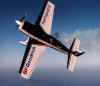
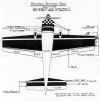
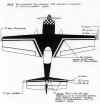
It's a great, great airplane. It's very reliable, very strong, and low on maintenance problems. It rolls great....400 degrees per second. It's easy to maintain on the road and has an American-made engine. It flies great in all weather conditions. I recently bought a new plane, and I thought about other models while I was looking, but after looking at them all I came back to the Extra....it's the best for me.
As for its cons, well, there are aerobatic planes now that have faster roll rates, and others that tumble better, but I'll stay with the 300.
What other aircraft have you flown in performances?
For performing, I've flown the T-6,
Pitts, and all types of Extras. Last year, I also demoed the
Raytheon T-6A Texan II.
Any aircraft that you wish you could fly but never have?
I've been lucky, and I've flown in a lot of planes, including military jets. If I had to choose, I'd say that I'd like to fly more jets, but you can't do the same kinds of aerobatics in them.
You recently experienced some traps and catapult shoots from the backseat of an F/A-18 Hornet. What was that like?
It was just awesome...easily the most physically intensive flying I've ever done.
COMPETITIONS
Describe how an aerobatic competition works.
There are many different levels of competition. Regional Competitions are one- or two-day events, and there's about 40 of those across the US every year. The Nationals are once a year, and they last about a week...usually down in Texas. The main international competition is usually every two years, and this year's was in France. The amount of flying in each of them varies based on the type of competition. In the Nationals, you fly every day. In the world competitions, you only have three or four flights over the course of two weeks, so it's easy for you to get very rusty.
How far in advance do you start preparing?
When you're actively competing, you really train all the time for it. If I knew a big event was coming up, I'd plan an intensive training session for a week before they event and then work to build up to that training. For a September event, you typically start training in March....you can maybe push it back to April, but no later than that.
You train and train and train, up to where you peak out, and then a couple of days before the event you get in one last practice. If you're a little peaked out just before the event, you're usually in pretty good shape.
How does it compare to an average airshow performance?
Oh, it's very different. Flying an airshow, you're going up once, maybe twice, a day. The stress level is totally different; there's really no stress at an airshow, because it's strictly entertainment. There's a lot of stress and tension in the competitions.
At the airshow, though, there's lots of pressure to do more media interviews, sign autographs, and things like that. Air shows can be very exhausting, but they're very different from competition.
THE BUSINESS
Talk about your company a bit….how many aircraft do you have? Staff?
Patty Wagstaff Airshows has three airplanes: a Baron, a T-6, and the Extra 300 Special. The Baron is our support plane. We have four staff in total...an all-female crew. We're the "chicks with sticks."
I think a lot of people wonder what the air show business must be like… How competitive is it?
It's pretty competitive. Some of the personalities involved are very competitive people by nature, and you have to deal with that. Not me, of course. (laughs) Some want to be considered as the top and they're not always considered that way by others. From a business standpoint, one of the toughest parts is that there's not enough sponsorship out there and it is very hard to get a sponsorship deal. You sometimes hear of people hitting on each others' sponsors...that type of thing. In that respect, I guess it's not that unlike other businesses. One difference is, though, that in the airshow business, anyone would do anything for anyone else. We're a small group that gets very close and we've lost a lot of friends through the years. We'd do anything for each other.
When you're not flying, are there any performers out there today that you enjoy watching?
Yeah, I never get tired of watching Jimmy Franklin, the Canadian Snowbirds, and Michael Goulian.
Do you review videos of other performers?
Sure. Sometimes I do.
I'd imagine it's mutual too.
Oh sure.
Are most of the air show performers also competitors in US and International Aerobatics Championships?
It's really a totally different crowd. A lot of airshow pilots probably have competed in the past, but it's very hard to do both at the same time.
You also fly for movies and television and are a member of the Screen Actor's Guild and the United Stuntwoman's Association. What's that kind of work like?
I love it, especially the coordination with the film crew. It provides something new and different each time I do it...every job is different.
You also help train other performers…..how hard is it to transition from being a pilot yourself, to watching another pilot learn the art of aerobatics?
It's wonderful, and in fact, for me, it is what it's all about. I still do some training and I really enjoy it. I've always thought that when you are training someone else, the better they do, the better you do. For example, one thing about competitions is that you more or less all travel together, and as you practice, you all scrutinize and criticize each other, but then you go out and try to beat each other.
How does the average pilot get started into aerobatics?
To start with, you need to take lessons with a good instructor, and you really need to find an instructor whose style matches your own. There are lots of different aerobatic planes to start off in, but you need to find a plane that you just feel good being in. Ideally, you also should take a 10 hour course in aerobatics as well.
FLIGHT SIMS
Have you tried many flight sims? What did you think of them?
Well, I've been involved in Microsoft's Flight Simulator line since 1995, so I'd have to say that's the one I've tried the most. It's amazing for me to see what they've done with it since that time. When I try it, I usually avoid the typical stuff like shooting approaches...I like to fly upside down between buildings and things like that.
How did you get involved with Microsoft?
I helped them work on a CD-ROM reference guide to aviation called "The World of Flight" and right after that, they asked me to be involved in the Flight Simulator line.
Any future plans with them?
Yes....I'll be working with them on future versions of Flight Simulator.
If you were given free hand to design a flight sim revolving around aerobatic flight, what would be the most important factors that you'd want to put in?
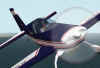
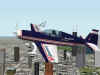
I think realism in the flight is most important. I'm impressed that the 300S in the game really performs like mine. While they were making it, Microsoft sent some people out here. I took the Extra up and did some maneuvers so they could measure specs for the game....things like takeoff run distances, etc.
While I'm doing airshows, I get a lot of questions from people who have tried Flight Simulator. They usually ask "Does this really fly like your plane?" and I like to be able to say, "Yes, it does."
Patty, thanks for the taking the time to speak with us today.
Thank you!
RELATED LINKS
PattyWagstaff.com - Patty's official home page.
Patty's Videos - RealVideo and downloadable videos of Patty's performances, including a 1998 commercial for Shell featured during the Olympic Games.
Microsoft's Flight School Lesson on "Flying The Loop" with Patty.
Copyright 2002 SimHQ.com. Reprinted with permission.