
All images below are thumbnails only; Full versions may been seen in the SimHQ article linked above.
An
Evening With The Tuskegee Airmen
by John
"Spoons" Sponauer
Originally
Published May 9, 2001 at
All images below are thumbnails only; Full versions may been seen in the SimHQ
article linked above.
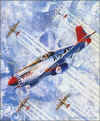
"The Shepherd" by Troy White
Available at AviatorArt.com
*
That was the chance recently given me when, through a statewide USAAF group I belong to, I learned of a presentation by five of the surviving Tuskegee Airmen, the African-American pilots and crews who flew in the 99th Pursuit Squadron, the 332nd Fighter Group, and the 477th Composite Group. The Tuskegees were speaking at an event designed to raise funds and awareness of a new museum starting up in my neck of the woods, the American Veteran's Museum, and I knew this was one talk I didn't want to miss.
Nor, apparently, did about 300 others, because the Knights of Columbus Hall in Torrington, CT was jammed packed. Fathers with their sons, fellow WWII vets, families...all turned out to hear the amazing stories of some of WWII's heroes.
And were we all ever in for a great evening. Three of the speaking airmen, Lt. Col Spann Watson, USAF (Ret), Lt. Col. Bertram Wilson, USAF (Ret), and Lt. Col. George Hardy, USAF (Ret) were fighter pilots in the 99th and 332nd. The other two Tuskegees also had extremely interesting pasts....Flight Officer Connie Nappier Jr. was a Bombardier/Navigator and was involved in the Freeman Field incident, and Staff Sergeant Calvin Stoner was a photographer at Tuskegee Army Air Field. All men were extremely generous with their time and tolerance in answering the cascades of questions from those attending.
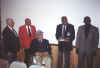
The five visiting Tuskegee Airmen
Lt. Col Hardy, Lt. Col. Watson, SSgt. Stoner, Lt. Col. Wilson, and
Flight Officer Nappier
Photo source: author
THE TUSKEGEES IN TRAINING AND WAR
Lt. Col. Watson spoke first. A decorated veteran of 32 combat missions in the P-40, he returned to the US and became a flight instructor, and served post-war as the Operations Officer for the 99th, flying the P-47N. He retired from the USAF in 1965 and then retired as an Air Traffic Controller with the FAA in 1992. Spann first attempted to join the USAAF for pilot training in 1939 but was rejected on the basis of race....he went to Howard University instead and studied mechanical engineering, eventually also earning his private and commercial pilot's license while there. When the NAACP filed suit to get the Army to open up an integrated flight training program, Watson applied again, and was accepted in 1941 in the fourth class of black pilots to be sent to Tuskegee Army Air Field in Alabama.
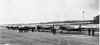
Training at Tuskegee AAF
In the book "The Right to Fight: A History of African Americans in the Military" by Gerald Astor, Watson describes the training program.
"Our group had already taken ground school and flight training and had exceptional records. The instructors, Guido, Rosenburg, Camilleri, Shelton, and Anderson, were excellent and there was no racism from any of them. I stayed away from the city [Tuskegee] to avoid any trouble there. When I finished the course in March 1941, I had been to Maxwell Field. I saw bigotry at its worst and fair play at its best. Colonel Parrish was the greatest guy around. He said, 'I'm a pea-shelling redneck from Georgia, but we're here to do the job.' While we were cadets, he was cordial, respectful, a friendly guy. You knew where you stood, that he'd do the right thing. The military pilots who taught us were great guys. They were strict, and gave you hell if you screwed up. But I didn't think they behaved badly."
At the event, Watson spoke about his underlying motivations for serving.
"The day after the first class got in [to training], it was a call for black husbands, fathers, and brothers to do better for themselves. We were not going to be stopped."
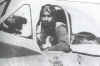
Lt. Col. Spann Watson
Photo source: "The Right To Fight" by Astor
He talked a bit about Colonel William Momyer, who actively worked to discredit the black flyers, and then the change in morale when a new commander, Col. Philip Cochran, took over the 99th and "just let us loose." Addressing the situation in the North African theater and in combat, Watson answered questions about whether there was a sense of racism in the air.
"Let me explain something...when you're at war, there's no bigoted people in the air. We did very well, and if you wanted to ask anyone about that, ask the pilots of the B-17s and B-24s [we escorted]. There weren't blacks in those planes, but we got them home just the same. Some of them had Confederate flags and such on them then, but today, some of our closest friends are those pilots."
Watson then talked about his feelings of race in America, making some interesting points about racial profiling and police shootings in America today. He ended on a high note, however (it's actually interesting to note that they all did during the evening).
"From the day I joined until today, I've never gotten rich, but I've never been poor, either. The opportunity [for blacks] is not perfect, but you can get there if you apply yourself."
"On Target" by Ric Druett
Available at Allencreations.com
*
Lt. Col. Wilson, a two-kill P-51 pilot from the 302nd Squadron ( 332nd FG) who went on to fly the F-86 postwar and the RF-4 in Vietnam, chimed in, adding that he agreed with all of Spann's points and that "we had one thing to do....serve our country."
Lt. Col. George Hardy spoke next. Hardy flew 21 missions in the P-51 with the 99th, 45 missions as a B-29 pilot in Korea, and 70 missions flying the AC-119 gunship over Vietnam. In late 1943, he took the USAAF cadet exam at the age of 17. By the middle of 1944 he was in combat, the youngest Tuskegee pilot in-theater. Hardy spoke of their legendary commander, Gen. (then Col.) Benjamin O. Davis, who impressed upon his pilots that to escort the bombers well, they had to stick with them and not go chasing off after the Luftwaffe when they attacked and then ran. Perhaps as a result of this tactic, the Tuskegees only saw one ace emerge from their midst, but had the more enviable claim to fame of never having lost a bomber to fighter attack while they were escorting it, over the period of 200 escort missions.
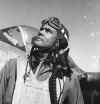
General Benjamin Davis
"If you left the bombers, you'd hear it from [Davis]," Hardy noted, adding that because they were present near their charges in great numbers, there was often a better likelihood they could split off a fighter or two to escort damaged bombers home.
Wartime clearly left an impression on Hardy.
"We lost a lot of people," he said. "Just thinking about my classmates...I had 23 graduate with me in my class. Just a few months later, six were dead. The losses were just accepted...it was war."
In the summer of 1945 with the war in Europe over, Hardy and other Tuskegees were sent stateside and formed into an all-black composite group, the 477th, with the intention of going to the Pacific Theater. On the way to war, they learned that the atomic bombs had been dropped and the Second World War was over. Hardy left the service in 1946 and was called back for Korea. Retired from the USAF and since also retired from GTE, he spoke of the vast changes he's seen in his life in how he and other blacks were treated.
"It's hard for me to explain what segregation was like. I could sometimes pass as white, but you always just felt different. A few years back, I was flying through Atlanta. I noticed in a magazine there that the airport manager was black. You know, during the war, we were on a training flight and had to land there because of an approaching storm. We couldn't get served."
I had the honor of getting some one-on-one time with Lt. Col. Hardy prior to the event. I asked him if the German pilots knew they were fighting black pilots when they saw they were tangling with the "Red Tails" (so named because the Tuskegees painted the tails of their aircraft red as a unit mark).
"Oh, they knew. After the war, we learned from some of our POWs that the Germans had a large set of books about all the fighter units, and they knew we were black. That was sometimes used during interrogation....they'd say things like 'Why are you fighting for a country that doesn't treat you equal?'"
When I asked him if he thought the Germans underestimated them because they were black, he smiled and shared a gem of fighter pilot wisdom.
"When you're in air combat, you don't last long if you underestimate the other guy."
"Two Down....One to Go" by William Philips
Hardy had respect for the Luftwaffe and their aircrews for their fighting ability, adding "they were very good pilots....and some were extremely good. But by the end of the war, they had experienced terrible attrition. They may have had a strong air force in 1939, but by 1944 we just outclassed them. It was the same with the Japanese....they had some very good pilots, but we just outlasted and outfought them over time."
The next to speak in the evening's program was Flight Officer Connie Nappier spoke of his experiences at the Freemen Field incident, where more than 100 Tuskegee officers were arrested after trying to get service at an officer's club at Freeman Field, Indiana.
Nappier graduated high school in June of 1943 and immediately enlisted in the Army. By August, he was in Biloxi, Mississippi, undergoing Infantry Training. Eventually applying and being accepted in the flight training program at Tuskegee, he reported there next, with the intention of becoming a fighter pilot. The Army had other plans.
"We were awakened one morning and promptly told that the USAAF had a pressing need for more bombardier/navigators. I don't think any of us wanted to do that. Each of us were invited to voice our objections to that...if you've ever been in the military, you know what good that will do....it was clear that the decision was already made," he said.
Nappier was sent to Midland, Texas to undergo bomber navigation training, and found some of the cards stacked against both himself and the other black recruits.
"During each navigation exercise, when we passed, we were accused of cheating. They couldn't believe that blacks could do the job. But when it was time at the end to recognize the success, the awards were given to our white officers who trained us. We were told that we succeeded because the instructors were good, not that we were good students."
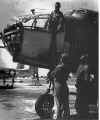
Tuskegee B-25 crew
Sent to Goodman Field, near Ft. Knox, Kentucky, the flyers and the USAAF soon realized that the facility there was too small for a B-25 unit, so the officers were sent ahead to Freeman Field to set up their segregated facilities there. Nappier described the events leading up to the mass arrest, and said that the feeling among the aircrew was simple.
"We were told that one of the penalties of breaking the military code we were sworn to was execution. We figured that we were going overseas to war anyway; we had to stand up for what was right."
The officers were eventually released from custody, and sent back to Goodman Field, where they were told that with the war almost over, the USAAF didn't need any more bombardier/navigators. Although Nappier ended up back in the class of 46D back at Tuskegee Field, the training program was disbanded shortly afterwards and he went into the civilian workforce, where he graduated from school as an architect, a trade he still practices today.
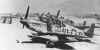
Tuskegee P-51s
Those of the airmen who stayed in the service after the war went on to describe some of their experiences in the turbulent years following....the establishment of the USAF as its own service, the order to desegregate the military issued by President Truman. It was clear that although the law had changed, some attitudes didn't.
Spann Watson told a story of his unit's participation in the 1949 USAF gunnery meet in Las Vegas. The 332nd sent a number of pilots to compete against units from within the USAF and air forces around the world. Although the 332nd won the award that year, the trophy was stolen and not sent to them. Little else was thought about the event until about 15 years later, when some of them noticed a listing of the past winners of the meet. The 1949 event was shown to have "No winner." The vets assembled their documentation from the meet, and eventually received the recognition they deserved for their victory.
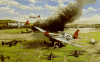
"Red Tail Fury" by Ric Druett
Available at Allencreations.com
*
George Hardy also spoke of some of the difficulty finding housing....although the order had been issued to desegregate, he was refused on-base officer housing for himself and his family because the officer in charge told him that he hadn't received the updated paper regulations yet that removed segregation. The civilian state he was in at the time was still segregated by law, but he and his wife and daughter moved off base.
When the Korean War flared up, he was sent to join the 19th Bomb Group, flying the B-29 out of Guam. Although the crew worked well together, Hardy's squadron commander wouldn't speak to him at all. Just prior to one mission they had long planned for, the commander pulled Hardy off at the last minute and replaced him with a white crewmember. Although he wanted to go, Hardy accepted that and didn't think much of it until later in the day, when the squadron commander pulled him aside and told him that the B-29 had been shot down with a full loss of crew.
As the years went by and Hardy's USAF career took him to different installations, he found himself in Plattsburgh, NY in 1960....and little did he expect to see that his new commander was the same one he had in Guam. This time, though, he was more sociable, and in fact would talk in the Officer's Club about how he "flew with George in Korea."
QUESTIONS AND ANSWERS
After the hour-long talk, the floor was opened up for questions. Among the more popular topics was the Group's tangling with the Me-262 jet. On March 24, 1945, the 332nd flew the longest mission by the 15th Air Force....a bombing escort mission to the Daimler-Benz tank works in Berlin, more than 1,600 miles round trip. Lt. Col. Bertram Wilson flew on that mission, which he described as "a 7 hour, 10 minute mission flown with 7 hour, 15 minutes worth of fuel." He described the scene as a force estimated at more than 30 Me-262 and Me-163 fighters descended on the bomber formations some fifty miles from their target.
"The jets were all around us, like gnats," he said. "[The 262] was much faster than our Mustang. The only way to get them was to either attack in a dive if you were above them, or get them to go into a turning fight with you."
Three Tuskegees scored jet kills on that day, Roscoe C. Brown, Jr., Charles Brantly, and Earl Lane, the first Me-262s downed by the 15th Air Force, and one of the first downed by any USAAF pilot.
In Astor's "The Right To Fight," Brown describes the event.
"Over Berlin I was in command of a flight and I flew as the Tail End Charlie while trying out a new flight leader. The other fighter groups arrived late, so we had to continue escort of the bombers while they were dropping their bombs. I noticed at nine o'clock, two jets. I said, I'm taking over, drop back.
"Drop Tanks...Follow Me" by Ric Druett
Available at Allencreations.com
*
I dove down to straight below the level of the bombers while the enemy planes came in from the left. I made a wide turn to let my guys get behind me and make closure. After a reverse turn to the left, then hard right, I put the circle of my new gunsight around the wings of the target. The old ones you had to figure leading the target, but these did the job for you. I fired. The canopy of the jet flew off and after the pilot ejected, the plane blew up. The other guys with me followed jets down and scored some hits. One of the jets went into the ground.
I was now all by myself when I saw another P-51; I recognized it by the square wings. But then I saw that it had German crosses on the wings. It was a plane they had somehow captured and infiltrated into our formation. I went after him but as I was gaining on him, I started to run out of fuel. When I landed, my engine literally cut off.'
Brown was the first man in the 15th Air Force to shoot down an enemy jet. In celebration, he took up his refueled aircraft and indulged himself with some hairy acrobatics over his base, zooming down to tent-level height, roaring up and down the company street, including at least one upside-down pass, racing beneath the telephone wires that linked headquarters with other units."
Other questions for the airmen included how it felt to be a young man of 18 or 19 and be handed a fighter aircraft like the P-51. Spann Watson said it all:
"After two years of being told that I couldn't do it, when I finally got it.....I felt like I was king. It takes a lot of ego to be a fighter pilot. The spirit is 'Give it to me, and I'll do it.'"
At that point, an older gentleman in the back of the room stood up to speak. He said that he was a B-17 crewman, and wanted to thank the airmen personally. During the war, on the flight back from a mission, his B-17 was damaged and was headed for the island of Vis, off the coast of Yugoslavia, for an emergency landing. He said that he clearly remembers at least one sold red-tailed P-51 pulling alongside, escorting the damaged bomber to safely.

Painting at the presentation of a B-17
and a "Little Friend"
(photo: author)
Another person wanted to hear the story of one of the 332nd's famous tales....the sinking of a German destroyer off the coast of Trieste, Italy by a flight of Tuskegee P-47s.....using nothing but machine gun fire. Spann tried to describe the power of eight fifty caliber machine guns in the Thunderbolt, and said that while destroyers are hard targets, in this case they hit the ship at just the right spot and apparently ignited the magazine.
Other questions included asking if the system supported the 332nd the same as white units when it came to supplies and missions (all said, yes, they believe it did), how their POWs were treated by the Germans ("They were treated as military officers."), and even how they flew such long missions in such uncomfortable cockpits ("You learn what you have to do, and you just do it.").
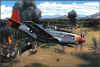
"A Perfect Record" by Stan Stokes
Available at Aviatorart.com
*
Some of the Tuskegees took note at how few of them were remaining. Spann Watson estimated that out of all the 99th Fighter Squadron, there are only 8 or 9 pilots alive today, and maybe 100 ground crew. Looking back, he made one comment that stuck in my mind.....through all of the hardships that these men (and really, all WWII airmen) suffered, and all that they did, it is easy to forget one thing.
"We were just a couple of black guys.....ordinary guys who were given an opportunity to do extraordinary things."
If there's one quote that summarizes my experiences with men of this generation, that would be it. Ordinary men who performed extraordinary feats. After my evening with the Tuskegee Airmen, I consider myself a richer and luckier man because of their blood and sweat.
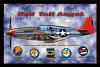
"Red Tail Angel" by Dwayne Holt
Available at Ebony
Wings *
Some Statistics About the Tuskegee Airmen
| Aircraft Destroyed (aerial) | 111 |
| Aircraft Destroyed (ground) | 150 |
| Ground vehicles Destroyed | 950 railcars, trucks, and other motor vehicles |
| Destroyers | 1 |
| Total Missions (12 AF) | 1,267 |
| Total Missions (15 AF) | 311 |
| Total Sorties | 15,533 |
| Pilots Graduated at TAAF | 992 |
| Pilots Sent Overseas | 450 |
| Total KIA | 66 |
| Total POW | 32 |
| Commendations | 150 Distinguished Flying Crosses, 744 Air Medals, 8 Purple Hearts, 14 Bronze Stars |

Scale models displayed at the presentation, along with information
about the airmen
Unless noted otherwise, images in this article taken from one or more of the following web sites:
Acepilots.com - Tuskegee Airmen
Visionquest.com - Tuskegee Airmen
* NOTE ON ALL ARTWORK: Neither myself or SimHQ.com take any responsibility for any orders placed through the online vendors mentioned. They are listed solely for convenience.
Copyright 2002 SimHQ.com. Republished with permission