
All images below are thumbnails only; Full versions may been seen in the SimHQ article linked above.
The Carson
Brothers - WWII in a B-17
by John
"Spoons" Sponauer
Originally
Published January 14, 2000 at
All images below are thumbnails only; Full versions may been seen in the SimHQ
article linked above.
Author's Note:
I have been a member of the Heavy Bombers and B-24 Internet mailing lists for
some time now. In that time, I've come to know many of the other list
members, some of whom were crew members from WWII or family members trying to
learn more about the relatives. It didn't take long after I joined to come
to know and respect John and Gene Carson, twin brothers on the Heavy Bombers
list, who have an incredible story to tell about their service in WWII.
They are both regular fixtures on the list, helping to answer questions from new
list members, participating in the list dialogue, and really adding to the
online heavy bomber community that I value so much. I consider them
American treasures, and I think you will see why shortly.
With the Wayward Design / Hasbro's B-17 Flying Fortress II flight simulator just a few months away, I thought it would be interesting to introduce the sim community to the real deal. Oh, the stories these two can tell! I hope you enjoy reading this as much as I enjoyed writing it. My thanks to Gene and John for showing this writer the way it was. Their patience and understanding in answering my questions made my job much easier.
-John "Spoons" Sponauer
P.S. The pulled quotes in red are from two sources: Gene Carson's book draft "Bandits at Six O'Clock," [NOTE: Upon publication, the book was renamed "Wing Ding: Memories of a Tailgunner"] and John Carson's Online Biography (link at the end of this interview). The screenshots included are from three flight sims: the upcoming Wayward / Hasbro B-17 Flying Fortress II, Microprose's European Air War, and Jane's WWII Fighters. The photos at the end are published with the permission of Gene and John Carson.
Thanks also go to Dan "Crash" Crenshaw and Pete "Pygmy" Marone of SimHQ.com for helping to develop some of the questions and take some of the screenshots.
I have to ask the obligatory question….you're twins. Who's older and by how much?
Together: John is older, by fifteen minutes.
Did you enlist or were you drafted? If you enlisted, why? How did you end up in bombers?
Gene: We both enlisted. John went in immediately after high school graduation and I followed about five months later. I guess I enlisted because it was our country and there was a need to serve. Our father died when we were about one year old. He suffered from phosgene gas poison in WWI and developed TB in those days, commonly called galloping consumption. How I ended up in bombers is a long story....I'll answer that down a little further.
John: As Gene said, I enlisted...I felt it was my duty. I then volunteered for bombers.
How did your family handle both of you serving in such similar and dangerous job?
Gene: There is not a doubt our mother and those other relatives close to us endured the moments of agony. However our mother supported everything we did. She never said don’t do it. Her words were primarily, "Do it well."
John: Mother was very upset when I informed her on the eve of my high school graduation that I was leaving for the USAAF the next day.
|
As the formation turned on the bomb run the flak intensified. There was a feeling of vulnerability when the bombardier announced, "Bomb bay doors are open," followed by a psychological feeling of relief when the bombardier called out "Bombs away." The aircraft gave a significant indication; it surged as it was relieved of the extra weight. On this particular mission, old hands reported the flak as meager. However, sixteen of the twenty-one aircraft suffered flak damage. -Gene Carson, Bandits at Six O'Clock |
In what time period did you fly and with what unit?
Gene: I flew my first mission September 26, 1943 with the 8th Air Force, 388th Bomb Group, 560th Squadron, as a tail gunner. I was on the same crew for the entire tour. The twenty-fifth and last mission of that tour was on February 13, 1944. When I arrived in England for a second tour, the gunners were sent to the wash. They tried to keep me there as an instructor. I skipped out and went directly to the 92nd Bomb Group, 327th Squadron and found myself without a crew. I farmed myself out flying with anyone who would have me. Many of my missions in those days, September 1944 to January 1, 1945, were not even accounted for. I just got on for the ride. I had no trouble finding a tail gunner willing to take a rest. I think I flew with about fourteen different pilots or crews. Finally on Jan 1, I was picked by a pilot who needed an engineer. When the war ended, I became the Squadron Commander's engineer and went to North Africa. Even though I had well over enough points to rotate a couple of times, I stayed.
John: I flew combat with the 15th Air Force, 2nd Bomb Group, 96th Squadron, out of Masacult, North Africa (near Tunis) from early August 1943 until early December 1943, when the unit moved to Amedola, Italy. I flew 23 missions as a B-17 tail gunner and then five as a B-17 radio operator. I was shot down on Dec 20, 1943 by a direct hit from an 88mm gun, which severed the tail of the plane off at the waist door. We were bombing Eloysis Airdrome, in Athens, Greece. I was a POW until April, 1945.
Could you please describe your duties on the plane?
Gene: On the first tour I was a tail gunner. On my second tour, I was a flight engineer. I am sure the duties of a flight engineer would vary depending on the pilot and what that pilot wanted his engineer to do. I spent a lot of time on the flight line with the ground crew chief. I helped them work on the airplane and get it ready for the next time we would fly. On takeoff, I would survey the instruments and called the air speed. The copilot also did the same and was prepared to take immediate emergency action. Many times the takeoff was instrument and the pilot was paying attention to a smooth transition from ground to air and then a steady climb, usually straight ahead, until we reached 500 feet. It was then that we commenced our turn and continued climb, all the time wondering exactly where the other airplanes were located. Midairs were a common cause of death.
In the air until fighters were evident, I paid a lot of attention to the engines. If the landing gear was not functional, I cranked it up or down...the same went for the bomb bays. When fighters were present I manned my guns...the top turret had excellent tracking and range finding capabilities. On landing I called approach air speed and made sure all of the enlisted crew were prepared to land. Bomb bays closed, ball turret guns up in a horizontal position and wheels down.
John: As a tail gunner, my duties were to protect the plane, as well as keep the pilot informed of losses or planes in trouble. As a radio operator, I would monitor the ground station, send "bombs away" messages, advise the pilot and bombardier as to the status of the bomb bay, and use the radio room's .50 caliber machine gun.
Before you saw combat, did you feel your training was adequate?
Gene: What a joke that is for me. I probably was well trained, but it was all training that I managed to arrange without sanction or approval. I had always wanted to fly, but was assigned to the US Army's Cook and Baker's School. Fortunately, I was stationed at several airfields, and was able to "bum" rides off of pilots from time to time. I really felt the need to get out of the cooking and into a plane. I forged a letter to the President from my mother requesting that her two boys be stationed together at John's base in Rapid City, South Dakota. "Mother's" letter worked exceedingly well, and I got an unusual transfer order and was sent to Rapid City. During processing, I lied and said that the USAAF Gunnery School was going to send my records along to them. I was put on temporary duty as a clerk, and then, about two weeks later, was put into a pool of replacement aircrew. I was assigned to a B-17 as a tail gunner shortly thereafter. My crew was very suspicious of this lowly corporal who just showed up, but after some time on the skeet range and in the bar, I was accepted.
John: I am sure we all were apprehensive but also cocky and confident. Our training made us into a team.
Could you please describe your first combat experience? What was going through your head?
Gene: My first mission was a nothing and gave me a chance to learn about high altitude and cold weather survival. My second mission was over the port area of Emden, Germany. We had P-47 escort, but they had limited range. There was only meager flak at the target, and we dropped our bombs without difficulty. However, we were then attacked by about 25 to 30 German fighters. In a short span of time, my guns jammed, we were hit in the vertical stabilizer right near me, and my electric heating suit disconnected. When we got back to base, I had a shot of whisky to calm down. They told us that we weren't flying for three days, and they made us work on aircraft recognition...someone had shot at one of the escorting P-47s.
John: Fighters coming in from the rear. I was so scared I think I momentarily went blind.
|
A third flak burst had struck us at the waist door or slightly aft of it, severing the entire tail from the rest of the plane. I never saw the blast. Immediately afterwards I could see someone struggling amongst the dust and smoke in the waist as the plane rolled over on its back. We were at 21,500 feet and headed down. The engines of the plane were screaming. I found myself looking at the ground through the top of the plane, straddling the radio gun with both feet hanging out in the slipstream. There was no way I could get out. Realizing that I was trapped, I tried to cover my fear by fainting, but it didn't work. For a moment I thought "This is going to cut my legs off." Then the full realiztion hit me, "No, it is going to kill me." My only thought now was "Please God I don't want to go to Hell." Somehow I found the strength to extricate myself and went back through the waist and bailed out the end of the falling bird. I can still recall the moan of the engines, the jagged metal of the torn fuselage, and the jerk I gave the ripcord on that back pack. -John Carson, Online Biography |
What was it like flying in a multi-crew aircraft like the B-17? Can you describe the relations between the crew on missions and back at base?
Gene: When I was first assigned to the crew I was a corporal. Everyone else was a Sgt. I was a cook masquerading as a gunner. Had they known that, I would have been tossed out on my ear. I was promoted to S/Sgt. immediately prior to the first mission. I somehow did establish a rapport with the crew despite being a newbie. I was an outstanding skeet shooter and crippled a fighter on our second mission. After that, there never was any question of whether or not I belonged. Back at base, we did many things together as a crew, but when possible I was out looking for ladies. I had typical nineteen year old hormone problems.
John: We enlisted men shared a six man tent...we were close knit and did many things together. We looked after each other.
My own grandfather has told me of the awe in seeing so much metal and men heading for a target. Can you tell us what it was like being part of that? Did you even grasp what you were a part of?
Gene: During my first tour, and this applies to John as well, it is easy to recall days when my group put up fewer than twenty aircraft. Consider Schweinfurt as a major effort and we had about 290 some aircraft go to the target. Maintenance in those early days was not the best. When I came back in September 1944 to start my second tour, I saw it. The sky was filled with B-17s flying like a huge flock of crows coming or leaving the roost. I was overwhelmed. Maintenance had improved, equipment had improved. Waist windows were closed and engines had stand pipes to permit a better chance of feathering…also the turbocharger system had changed. I never flew one of the new Cheyenne tail gunner positions, so I cannot comment on that. I certainly did grasp what I was a part of.
John: Flying out of North Africa and Italy with the 15th Air Force in 1943, we did not have the large formations. I am sure we all realized our purpose, had learned the dangers, and sweated out what tomorrow would bring.
Describe the cold. How difficult was it to move about at altitude during combat?
Gene: The best way to describe the cold at 28,000 feet would be to say intense. Exposure meant instant frost bite. The electric suits in 1943 were real bummers. A burn out in the rear or between your legs would get your attention in a hurry. I guess we moved a little slower unless it was an emergency. In the tail I was not required to do much moving. I will confess...I used to catch catnaps. A couple of times I awoke to the chatter of someone’s guns or the thump of a round hitting us. Fatigue was terrible, especially after flying consistently for three days in a row.
John: The cold at altitude was always a threat. Movement at altitude on oxygen also was tiring and somewhat difficult. As tail gunner, a lot of movement was not normally required.
|
We crossed Belgium, and near the German border our fighter escort gave us a final an apologetic waggle of wings and turned back. We had been on our own for only a few moments when the Luftwaffe arrived on the scene. The Luftwaffe attack came with unbelievable ferocity. They outnumbered us at five to one or more. I watched in amazement as they lined up and barrel rolled through the formations with guns blazing. I could only assume they were doing the same to our group as fighter after fighter went streaking past the tail. They offered no opportunity for even a quick shot. Others sat behind the formation, out of range of tail gunners, and lobbed rockets into the formation. Again and again I watched the Luftwaffe line up on other groups and fly head on wing tip to wing tip. Their courage was unquestionable. They came in six at a time; diving and turning in attempts to draw fire while another fighter tried to make the kill. From the beginning of the first fighter attacks the Luftwaffe stayed with us. Long before we arrived over the target the sky was a constant stream of bombers and fighters going down in flames, exploding with bodies and debris claiming the sky. Parachutes were everywhere B-17s and Luftwaffe aircraft were going down and exploding. The ground below was marked with blazing debris and the smoking rubble of aircraft wreckage. Through some miracle all sixteen of our aircraft made it to the target. -Gene Carson, Bandits at Six O'Clock |
One simulation company recently told one of our editors that anyone not clothed for the waist gunner spot would not last more than minutes…was it possible to change positions in a pinch?
Gene: Changing positions would not have been a problem…however it would take a small man to fit in the ball turret and you really would be more comfortable not being too large in the tail. At the time I weighed about 145 lbs. For a waist gunner, strength and size could be important. It could take muscle to move the fifty around in the waist.
John: The waist gunner could perhaps come into the radio room, perhaps even switch with the radio operator if duties did not prevent it. The radio room on the open B-17 was also very cold. I cannot fathom anyone not wearing protective gear...exposure could be cause for serious injury or death.
What gear did you wear while flying? Did the gear carried depend on the position you occupied? Did you all wear helmets, flak jackets, etc., all of the time in the air?
Gene: On my first tour I wore the blue bunny suit, and on top of that fur lined pants and jacket with boots. Regular helmet and goggles. Gloves and the oxygen mask. I never wore a flak jacket. Did not even have one in the tail and as far as the flak helmet that too was not on my list of attire. I tried to use a steel pot on my first two missions. The rattle of the twin 50s made it jiggle to where I could not see. Never even carried it after a few missions.
On the second tour the clothing was somewhat better. The electric suits were far more dependable and lighter than the leathers. The oxygen mask had improved...demand type regulators, and a safety catch to prevent accidental disconnection.
John: I wore the heated infamous early blue bunny suit, and heated glove and boots, all prone to constant failure. I also wore the wonderful heavy leather sheep skin pants and the matching jacket...great stuff. For a helmet or hat I wore the leather sheepskin one. I rarely, if ever, used goggles. In my era we had no flak jackets, nor did we use the metal helmet.
What did you think of German forces before you saw combat? How did that change after you had been shot at?
Gene: I had been told they were good and what I saw did not come as a surprise. It was mind blowing. They would come through a formation lined up four to six abreast and rip in head on. They would move in on the tail in an attempt to kill the tail gunner knowing that would then put the aircraft at their mercy. They were brave, courageous and skillful in all they did. It was not possible to face them and think disparagingly of their valor.
John: We knew they were good before we entered combat. There was never a question about their outstanding skill, courage, or devotion to duty.
How would you rate the B-17 as a plane to serve in?
Gene: To me, the B-17 was the epitome of what a combat bomber should be. It was the only plane I would have wanted to serve on.
John: It was an outstanding plane.
What did you wish it had that it didn't?
Gene: I expect I would have liked to have had more heat…and there were several times when an extra engine would have come in handy!
John: Some of the modifications and later models improved it, such as shutting the waist windows.
What did you view as a strong point of the design?
Gene: The B-17 was structurally strong and very forgiving. When I flew as an engineer, I learned much about those qualities. However, the strong point of the B-17 and the B-24 were the crews. Gallant, guts, balls to the wall. We were never turned back.
John: It was structurally sound and would take a beating and still come home.
What was the funniest time you had in the B-17?
Gene: The funniest time would be the second mission when I had to pee and was under fighter attack. I held it with one hand and fired with the other, taking great care not to let it touch the frozen metal of the steel helmet I was going into!
John: It was funny afterwards, but once I thought I had been hit and announced so over the intercom. A fighter laced the radio room with machine gun fire and it kicked up a lot of dust. I saw red on a chute bag and thought it was my blood. After making an announcement that I was hit, I found it was just dry paint.
What is your fondest memory of your time in a B-17 unit?
Gene: I don’t know. Sometimes it seems like a dream. I think getting the Distinguished Flying Cross and finishing my first tour.
John: Crossing the Atlantic with our B-17 was a big step in our lives. I am certain we all had a lot of "What Ifs" on our mind as we embarked on this venture. It was now a realization that fun and games were over and we were getting down to serious business. When the pilot and navigator announced we had reached the point of no return, I realized I was going to war.
What was the most frightful time or mission that you had in the B-17?
Gene: No question here. October 14, 1943. "Black Thursday." The target that day was Schweinfurt. Thirty minutes in the air I discovered my parachute was on the ground…I decided to keep my mouth shut knowing a statement would cause us to abort. It was a bad mission. I think we were without fighter escort for about four hours. Another time was on the second tour when a copilot had an attack of panic and attempted to crank us out of formation. There was a short battle in the cockpit and the copilot relaxed with the help of a fire extinguisher along side his head. On another mission we had a softball-sized hole blown in near center of the windshield by a 20mm cannon.
Flares caught fire, and oxygen and hydraulic lines were burning…I threw the box of flares out of the open bomb bay and put out the fire. I felt pain lots of pain and knew I had been hit. I looked at my crotch and saw the enlarging dark stain. We were under fighter attack. I thought I had been castrated or even worse, had it all shot off. I lost one testicle…like I said, the pain was intense. The best part of it was later at the hospital…one of the nurses decided it should be tested. I thought that was kind. Guess that was not in a B-17, though.
John: I recall a crash landing once at night with just one engine running...another time was over Weiner Neustadt taking severe damage when I was flying as tail gunner. Another time was flying out of Italy, just six days prior to being shot down. We were badly mauled by fighters, and lost a right wingtip and took much other damage. The worst was when we were shot down. Only five of us got out of the plane. Four of us were captured, and one evaded.
What aspects of your time in the B-17 unit have significant impact on your life then and now?
Gene: I think I learned to look after my equipment. Pay attention to the little things and the big things sort of took care of themselves. I learned confidence and found I had courage. Ethics came later…but I slowly learned ethics were necessary.
John: What had the biggest impact on me was my POW time. It was a learning experience in so many ways...I went in a young man and learned much about living, survival, trust and faith.
Many people consider yours to be "the greatest generation." What do you think?
Gene: I never thought about it until Tom Brokaw used it for a book title. Perhaps we were. One thing for sure, we were tested.
John: We did well and it is nice to be thought well of.
SimHQ is a web site devoted largely to flight simulation. Have you ever tried a flight sim, especially one about WWII? If so, what did you think?
Gene: The first one I tried was called Secret Weapons of the Luftwaffe. Made the hair stand up on end flying in a B-17 again. I do not fly the jet set of sims, but have a collection of prop jobs sims and am really into WWII stuff. I sometimes fly on Air Warrior III. When I get into one of those games there is considerable remembering taking place.
John: In the past I spent considerable time playing Air Warrior. I enjoyed it.
Are you aware of Wayward Design's upcoming flight sim, B-17 Flying Fortress II? If you could create in a sim, one "experience" for the player to feel like being in one of these planes 50 years ago, what would it be?
Gene: I cannot wait patiently for this sim to come out. I have already invested in a new computer with sufficient RAM and speed to handle the sim.
John: Let them be a pilot, facing the rigors of formation flying, flak, and the indicated point, or be in any gunner position such as the tail, with fighters boring in.
Gene, could you please describe how you learned that your brother had been shot down?
Gene: I was at a Wings Club Dinner in the Waldorf Astoria, NYC honoring recipients of the DFC. I was given a free call home, which was a big thing in those days, and Mother told me that John had been KIA. I said nothing that night, but the next day embarked on a mission to return to the ETO and find my brother or kill those responsible for his death. Stupid kid, I guess, but my mind worked that way in those days. I stayed in for the duration. I was booted out of more Colonel's offices than you could shake a stick at because I kept pushing to return to the ETO. Finally they sent me to Dyersburg, TN, where I started to fly as engineer with pilot doing their final training on B-17s. Some of those rides were on the edge. I found a crew that had lost the tail gunner because of a health problem (he had clap). The pilot, a guy name Hertz, found out I had flown a tour, so he grabbed me and we took off flying the Atlantic via the usual route.
Gene, how did you learn that your brother was indeed alive?
I came back from my fifth mission on the second tour. I know I went to Merseburg back to back and then I think Kassel, Munster, and Kassel again. On my return from the Kassel mission, the Chaplain came to the airplane when we moved to the hardstand. He told me my brother was a POW. I was given a choice and offered a non flying assignment. I opted to continue to fly.
The story of how you two met again is amazing to me. Can you tell your respective sides of it?
Gene: When I went to London I met a lady named Adele Astaire. She worked as a volunteer at Rainbow Corners USO. When the war ended she arranged to have my brother come to England. We met on VE night in Rainbow Corners. By then I was a Tech Sgt. and John weighed 115 pounds.
John: As a POW, I was taken to Camp Lucky Strike in France. Here, POWs were cared for and rotated to the ZI. Knowing Gene was in England I made arrangements to have a delay enroute back to the states. I shipped out to Southampton on a British vessel and made my way to London. There, at the Rainbow Corners USO, I met Adele Astaire, Fred's sister. A gracious lady, she did a lot of work there to enhance the lives of service men. She got word to my brother, and of all times, we met on VE Day. That evening as I entered the club I spotted my brother walking toward me. Words cannot describe the warmth of this reunion.
He knew the ropes and saw to it that I was well
cared for. He took me to the famous Windmill Theater in Picadilly Square,
which was a well known burlesque show that never closed. There I met a
young lady who sang and danced in the show, a Miss Valerie Ware. We shared
some moments and I met her family. On rotating, I lost touch of them, but
they were fine people. I and five other former POWs went over and talked
to the Navy and signed on to be gunners on a high octane tanker going back to
Bayonne, NJ. The civilian crew treated us like royalty
What effect did both of you serving on bombers have on your relationship as brothers after the war?
Gene: I think John started to admire and respect me for what I did. He knew it was because of him that I returned to risk my life. Later when he visited me at Ft. Benning in 1948 where I was with an Airborne Demonstration unit, I took him to the Officer's Club. I motivated him to try for Air Force OCS. He did and he made it. He was a Reserve Air Force officer. I was integrated into the regular Army with permanent rank of Lieutenant Colonel. We steadily drew closer to each other, and to this day do not close a phone conversation or depart without saying, "I love you" to one another.
John: I think our service and experience made us appreciate each other. My brother and I share a love that is beyond comparison.
What made you both stay in the service after the war?
Gene: I found that I liked it. I liked jumping out of airplanes in the Airborne and I liked being an officer, although there were many officers I did not respect or care for.
John: I got out in September 1945 and was extremely hurt and bitter over the fact that my "bride" remarried about a month after I was reported KIA. This was a hell of a shock after my POW time. I do not think I received any mail from her during the 16 months that I was incarcerated. She told me the news in a tearful manner riding to her mother's place in Chicago. I divorced and remarried within a year but haunted recruiting stations. I reenlisted on April 1, 1947 as a S/Sgt, losing one stripe. Promotions were tough, as the NCO ranks were filled with former officers, so I applied for OCS and was accepted for Class 49A, graduating and being commissioned as a 2nd Lt. in July 1949.
|
As the fortunes of war turned against the Germans we were forced to evacuate our camp again as we had Stalag Luft VI. Only this time for the majority there was no mode of transportation other than "Shanks Mare", on foot. On February 6, 1945 we set out on foot into one of the toughest winters Europe had experienced in a long time. I had obtained two GI blankets and sewed them into a sleeping bag with shoe strings. I also had a GCI overcoat and a pair of new shoes. I had gotten my hands on Jello packs and any other small food item available in preparation of a tough trip. I buddied up with a man now deceased, a Leo J. Landy from New Jersey. He was a tough Irishman and a good choice. We later became separated and I formed up with another man, a Jack Kettler if memory serves me correctly. The days were long and arduous with snow storms, slush and snow on the roads. Hunger, wet feet and frost bite joined us in this mindless trek to nowhere. Constant companions were the body lice and dysentery. When fortunate we would find a barn to sleep in but there were several occasions where no shelter was available. It is difficult to impart what my personal thoughts were but I kept going by thinking of getting home to my young wife, having a home and raising a family. Had I known what the future held in that regard I am uncertain to how I would have handled it. I never took my shoes off at night. I basically wore them for 57 days then switched to the new pair I had carried and traded the old shoes for a loaf of bread. As we marched, Spring approached and life was a bit better, except for the lice and constant hunger. We kept it going one step at a time, much of it has been erased or pushed to the back of my mind, this I found the best way to ease the pain of the ordeal and take care of life as new days were ahead of me. To this day hunger or the thought of it is difficult to deal with. We were still marching when Liberation came in late April 1945 at Bitterfeld, Germany on the Moldau River by the 104th Timber Wolves, an American Infantry Division. The date was either April 27 or 28 but I do not honestly remember. As we marched through the front lines at Bitterfeld a pair of P51 fighters flew over us, canopies open and wings wagging. I am sure I was not the only man that choked back sobs of joy, our incredible journey was coming to a happy ending. German soldiers were also in the line of marchers coming in to surrender rather than to stay and face the on coming Russians. I noticed that the men in the trenches were all very young or maybe they looked that way. -John Carson, Online Biography |
Could you describe your postwar career?
Gene: After the war I returned to fly out of Washington National Airport with the VIP aircraft. I dated a WAC who was a personal secretary for General Eisenhower. We spent many an evening in his office at the Pentagon. I even got to sit in his chair and put my feet up on his desk. She was instrumental in motivating me to go to Infantry OCS, where I eventually became a paratrooper and finished my college education. I was integrated into the regular army and retired as a Lieutenant Colonel permanent grade with 80% physical disability in 1971.
When I retired I thought about doing nothing for a while. Then I took over the armed security for all of Hawaii’s airports. I did that for three years and then took a civil service exam to become the Liquor Control Administrator. I did that for thirteen years and then retired and opened my own consulting firm dealing with licensing. It has been successful. I am active in Rotary and a few other community projects. My main goal now is to write my book...I desire to actually finish three books.
John: I was assigned to the Air Force Security Service and served as a communications officer with them, which entailed managing communications centers as well as inspecting them. This service took me to Japan, Korea and Pakistan, Washington, DC and eventually back to San Antonio, TX. I then was given an opportunity to command a communications squadron at Kelly AFB, TX. and by then was a Major. Air Force Communications Service then asked me to take over an assignment at Kettering, OH, where the communications squadron operated what was known as an Autodin Switching Center. These computerized message centers handled enormous amounts of teletype traffic and the one at Kettering was large and plagued with management problems. I prevailed and was promoted to Lt. Colonel.
At this point, my eldest son was now a 2nd Lt. in the Marine Corps and headed for Nam. I wrote Gen. Stoney, AF Communications Service Commander, and asked for assignment to Nam as well. As a junior Lt. Colonel, I was awarded a real plum, a 1,000-man Squadron at Tansonhut Air Base in Saigon. My son John, then a 1st Lt. and a Company Commander, was killed on June 5, 1968, just prior to my arrival in-country. Gene arrived in Vietnam during February 1969 or thereabouts and was north of me at Long Binh. We fortunately got together occasionally. I left Nam and took over command of a smaller communications squadron in Japan and then rotated back to the ZI for retirement in February 1970.
Since then I have worked as a police dispatcher, fire dispatcher, and as a police officer. Now all I really do is ride one of my Harleys. My wife and I are members of the Blue Knights International Law Enforcement Motorcycle Club.
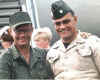
John and Gene Carson, Vietnam, February 1969
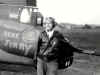
Gene Carson, 1943. Note the taunt to the
German fighters painted on the side.
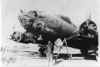
"Eager Beaver," the B-17 John Carson was shot down in.
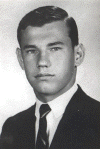
John Carson, USMC. John Carson's son.
KIA Vietnam 6/5/68
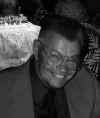
Gene Carson Today
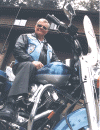
John Carson Today
Related Links
Heavybombers.com. The home of the Heavy Bombers mailing list and much more.
John Carson's Online Biography.
Gene Carson's Online Biography.
The "Virtual Vietnam Wall" Page for John Carson, USMC. Features information on his citations and Bronze Star.
B-17 Combat Crewmen. Dedicated to preserving the memory of those who lived, fought, and died in WWII in the B-17.
The following links were discovered at Bombs-Away.net
Tony´s B-17 page - A great resource on the B-17B-17 Flying Fortress Virtual Tour - Ever wondered what they look like inside?
Zeno's Warbird Video Drive-In - Among many other things, this site features original B-17 training videos in RealVideo.
Copyright 2002 SimHQ.com. Republished with permission.